The San Francisco Report — three days at AI Engineer Code Summit
Field report from AI Engineer Code Summit in San Francisco (November 2026) and internal benchmarks at TheFocus.AI: why software factories force a complete rethink of the SDLC around upstream feature specification and downstream frozen verification. Published as STATE No. 03.
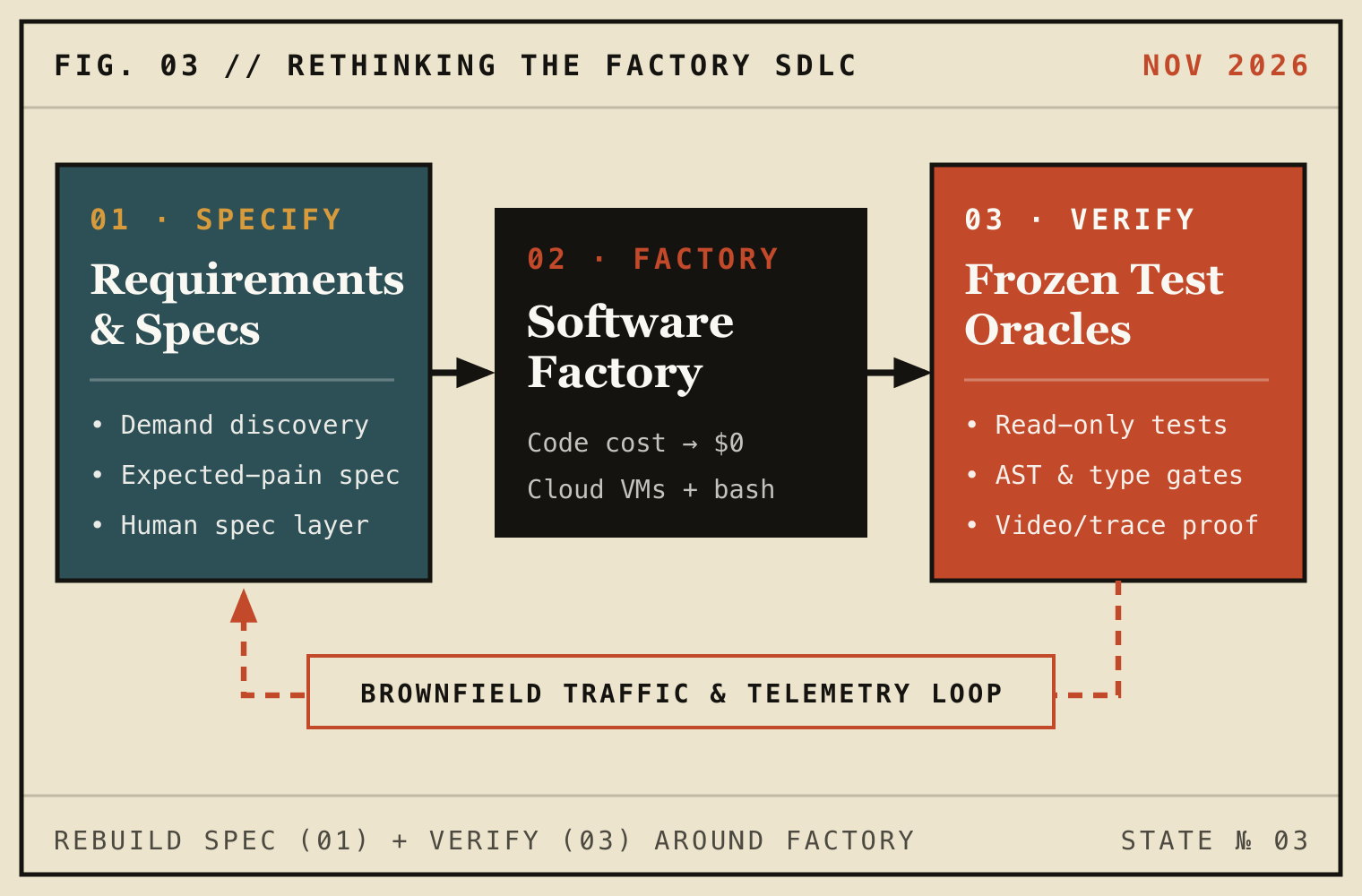
Three days of talks at the AI Engineer Code Summit in San Francisco (November 10–12, 2026), paired with our complete 33-talk interactive archive and internal benchmarks at TheFocus.AI. Across 33 sessions, teams running real software factories in production converged on a clear architectural lesson: once autonomous code generation in the middle drops toward zero marginal cost, the traditional software development lifecycle breaks unless you rethink both ends—how requirements and features get specified going in, and how frozen verification gates what comes out.
The main takeaways:
- Rethinking upstream requirements and feature specification. Unbounded greenfield loops amplify noise; reliable factories anchor to brownfield products with live customer telemetry, push discovery upstream into structured demand factories, scale feature specs by expected pain (strict specs on schemas, auth, and APIs; rapid visual prototypes on UI), and maintain a compact human-owned spec layer separate from agent-managed engine code.
- Frozen test oracles and deterministic verification gates. Because rewriting tests destroys trust in the oracle, high-output teams freeze pre-existing test suites read-only, push recurring review feedback into type boundaries and AST linters instead of bloated
AGENTS.mdfiles, isolate held-out tests outside hardened grading sandboxes, and sweep live production traces into regression checks. - Organizational maturity (
L0–L5) and full-stack pods. BuyingL4autonomous ticket-to-PR factories stalls withoutL2legibility (reproducible VMs, explicit invariants) andL3automated verification underneath. - Decision models, cloud VM assistants, and modeled data. Around the factory itself, routine classification moved back into deterministic code via fast typed decision models, personal assistants moved off laptops into isolated cloud VMs with scoped OAuth vaults, and modeled data warehouses with ACL-filtered search replaced live SaaS MCP sprawl.
The complete seven-chapter report, with benchmark citations and source links, is published as STATE № 03 · The San Francisco Report, alongside the searchable 33-talk field archive and 6 theme atlases.